A dike town. — In Figure 146 you see part of one of the dike towns which you pass. On some of the roofs are storks’ nests which do not show in the picture. What is on top of the dike? What shows you that the foundations of the houses are lower than the roadway? The posts under the little building on the right side of the picture help you to see how abruptly the dike slopes toward the water.
Taking care of the dikes. - In spring and autumn, the water usually rises so high in the rivers and canals that the dikes must be very carefully watched, especially along the rivers. Most of the dikes are built of clay, and there is danger that part of this day will be washed away when the river is high and its current strong. People try to guard them In many ways, for great harm may be done when a dike breaks. Trees are planted along the dikes. Each year the branches are trimmed off close to the trunk. This trimming makes the roots grow longer, and the roots help to make the dike firm. Some of the branches that are cut off are woven into mats. When the people fear that floods are coming, they cover the river slopes of the dikes with these mats and with bricks. The storks are useful, for they eat animals that burrow in the dikes. In flood times special men are sent to watch the dikes. Engineers who know how to build dikes and how to stop breaks in them are sent to stay in the dike towns, so that they will be near by if they are needed. Here and there along the tops of the dikes, materials that might be needed for mending them are stored. The engineers even have the right to tear down houses, if they need to, in order to get bricks for filling breaks in the dikes. Many stories have been written about the brave deeds and skillful work of these engineers.
Amsterdam. — On your trips through the Netherlands, you see towns and cities much larger than the little dike town partly shown in Figure 146. After Rotterdam, the largest city in the Netherlands is Amsterdam. On the map in Figure 137, find the dot just a little north of the one for Rotterdam. This dot stands for Amsterdam. To help control the water in their country, the Dutch have built dams at some places in the rivers and canals. Rotterdam grew near a dam on the little Rotte River, while Amsterdam grew near one on the Ainstel River. The picture in Figure 145 shows part of Amsterdam. What takes the place of a street in this part of the city?
Amsterdam, like Rotterdam, is a city not only of homes, some of which you see in Figure 145, but of many ships, and shops, and factories, too. Ocean ships can reach the harbors of Amsterdam by way of a canal from the North Sea.
Some of the people of Amsterdam work in cheese factories and in chocolate factories, just as people in Switzerland do, and there are besides many other kinds of factories. The Swiss, however, have many waterfalls to help run the machinery in their factories and the Dutch have not. Do you see why? The Dutch, on the other hand, living near the sea and near the mouths of the great Rhine River, have many big river and ocean ships, as you have seen. In some of these ships they bring coal from other countries for their factories.
There is one kind of work for which Amsterdam is more famous than any other city in the world. Ships that come from some far-away lands where there are diamond mines bring diamonds to Amsterdam. Many people make their living by cutting and polishing the rough diamonds to make them beautiful.
As in every city, some of the people are shopkeepers. In Amsterdam shops there may be seen things which Dutch ships have brought from many parts of the world. If you were there at the right time, you might see the fish-dealers’ shops gayly decorated with flags and evergreens. This is to let the people know that the fishing boats have brought in the first herring of the season. The Netherlands has been famous for hundreds of years for its fishermen, and herring are the most important salt-water fish which they catch.
Fishing villages. — Many of the fishermen who catch fish for the Amsterdam markets do not live there, but in fishing villages. One of these you see in Figure 147. Are the fishermen’s boats which are shown in the picture steam vessels or sailing vessels? Find in the picture one of the nets that the fishermen use. When you visit these fishing towns, you often see more women than you do men. Why is this true? In between fishing trips, however, many men may be seen along the shore mending their nets, repairing their boats, and making preparations for the next trip. Some of these towns are on the coast of the North Sea, and others on the coast of the Zuider Zee.
The Zuider Zee is an arm of the North Sea, and is north of the mouths of the Rhine. In some places it is very shallow, and the Dutch people plan to drain part of it to make more polders. Cornelius hopes that he will have a chance to help with this work when he is a man. When part of this sea has been drained, some of the fishing villages now on its shores will no longer be shore towns, but inland towns instead, and so will lose most of their fisher folk.
A Dutch sport. — In Figure 148, you see a picture taken on the Zuider Zee. At what time of the year was it taken? This picture shows you that in the winter you might see some things in the Netherlands which you could not see in the summer time. In the summer, you see hundreds of people riding bicycles. In the winter you see even more people skating. Most of the people in the Netherlands, both young and old, know how to skate. Suppose you lived in Amsterdam in one of the homes you see in Figure 145. Would it be easy or hard for you to find a place to skate when the canals were frozen over? Think, then, about the many rivers, canals, and ditches in the Netherlands, and give one reason why so many people there have learned to skate.
Some other signs of winter. — When the canals are frozen over, products are carried on them from place to place on sleds or ice barges. How does the sled in Figure 148 differ from the sleds you have seen?
If you traveled in the Netherlands in the winter you could not do so much sightseeing in one day as you could in the summer, because the winter days there are very much shorter than the summer days. At Christmas time, the sun does not come up till about half past eight in the morning, and in the afternoon it goes down about half past three. Does Cornelius have a longer Christmas day than yours, or a shorter one? Late in June, however, it is daylight there a little after half past three in the morning, and it stays light till almost half past eight in the evening. Are the days ever so long as this where you live?
The little boy whom you see in Figures 149 and 150 is Jan, who lives in a fishing village by the Zuider Zee. In Figure 149, he is pointing to the place in the southern sky where he sees the sun at noon on June 21. Notice the length of his shadow. Is its length greater or less than his height? In Figure 150, he is pointing to the place in the southern sky where he sees the sun at noon on December 22. Notice the length of his shadow. Long shadows at noon are another sign of winter where Cornelius lives.
More things to see. If you had time to make more journeys in the Netherlands, there are many other things that you might see. You might visit other towns and cities. You might spend a few days among the sand hills, or dunes, that in many places border the coast. Some of these dunes you can see in Figure 151. What would happen to the little village there if these dunes were destroyed? Notice the long, coarse grass on the dune on which you see the girls and boys. Grass has been planted on the dunes to keep the sand that forms them from being blown away by the wind. So long as the sand is kept where it is, the dunes form a great natural dike that protects the lowlands behind it from being flooded by the sea. In the southeastern part of the Netherlands you might go through lands that are not lower than the sea. In these parts that are not so low as the polders there are farms and grasslands in some places. In others, there are woods or waste lands. Most of the people of the Netherlands, however, live in its lower part.
Checking what you have found. — I. As you read about the Dutch people and their land, what thing did you decide was sometimes like a friend of the Dutch people, and sometimes like an enemy? The thing which Cornelius had in mind is written in italics in the paragraph about Amsterdam on page 105.
II. Each of the blanks in the following sentences should be filled either with the words "a friend" or "an enemy." As you read each sentence, fill each blank with the words you think belong there.
1. So long as the sea water is keptin the sea by the dunes and the sea-walls, it is like _________ of the Dutch people, for on it ships can sail between the Netherlands and many other parts of the world. From it the Dutch fishermen get many fish.
2. Whenever the sea water breaks through the dunes and sea-walls and floods the lowlands, it is like _________ of the Dutch people, for it destroys their crops, their pastures, their houses, and sometimes takes their lives.
3. So long as the water in the rivers and canals is kept within the banks or dikes where it belongs, it is like _________ of the Dutch people, for on it ships can sail to many parts of the Netherlands, and hundreds of miles inland to other countries.
4. Whenever the water overflows or breaks through the river and canal dikes, it is like _________ because it floods the lowlands.
Do the four paragraphs above tell the ways you had found in which water is like a friend and like an enemy of the Dutch people?
III. What have you decided that Cornelius wants to be when he is a man? He wants to be one of the people named by the last word in the paragraph "Taking care of the dikes," on page 105. Is this what you had thought he wanted to be?
IV. Which one of you made the longest list of things which the Dutch people do to make a living? What things did that pupil name that you did not? Do not add any of these things to your list till you are sure they are right.
A "mouth and source" puzzle. — You have now read about Switzerland, the high country at the head, or source, of the Rhine River, and about the Netherlands, the low country at the mouth of the Rhine River. Make a list like this:
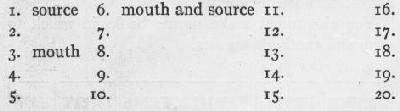
The first of the following sentences suggests the country at the source of the Rhine, so "source" is written after 1 in the list. The third sentence suggests the country at the mouth of the Rhine, so "mouth" is written after in the list. The sixth sentence suggests both countries, so "mouth and source" is written after 6 in the list.
There are 7 more sentences that suggest the country at the source, 7 others that suggest the country at the mouth, and 3 others that suggest both. The puzzle is to find all of these so you can then complete the list correctly.
1. Most of the land is sloping, and in winter time coasting is a favorite sport.
2. In some places in this land, people can go coasting even in the summer time.
3. It has many miles of sea coast.
4. It is farther north than the country at the other end of the Rhine River.
5. Many people who live here earn their living by catching salt-water fish.
6. Many people who live here earn their living by rearing dairy cows.
7. In this land it is not hard to make a long trip on a bicycle because there are so few hills to climb.
8. It has cold winters.
9. There is snow in some places in this land even in summer.
10. The mountain scenery is very beautiful.
11. Some people in this land work in factories where cheese is made.
12. Some people in this land work in factories where chocolate is made.
13. It is a land of many low pastures.
14. It is a land of many high pastures.
15. It is a land of many canals.
16. It is a land of many waterfalls.
17. Ocean ships go from this land to many parts of the world.
18. It is farther south than the country at the other end of the Rhine River.
19. In this land, towns now and then are destroyed by land slides.
20. This land is always in danger of being flooded.
Some things to think about. — Your travels in different parts of the world help you to see what important plants grasses are. You found that near the Nile, and near the Tigris and Euphrates, grass grows in some places where it is too dry for crops. You found that in Switzerland grass grows in some places where it is too high or steep for crops. You found that in the Netherlands grass grows in some places too wet for other crops. Wherever good grass grows, it helps people make a living. How? From which place could you get the most grass during a year — an acre of land in the drier grasslands, an acre of land in a high mountain pasture, or an acre of land in a Netherlands pasture? What, then, is one reason why people in the drier grasslands and in the high mountain pastures move with their animals from place to place, while people in the Netherlands do not?
Making a puzzle. — Perhaps you can make up a game or puzzle of your own about coasts, cows, and other things in the Netherlands that begin with "c"
A check. — In the "mouth and source" puzzle, sentences 1, 2, 9, 10, 14, 16, 18, and 19 suggest the country at the "source" of the Rhine. Sentences 3, 4, 5, 7, 13, 15, 17, and 20 suggest the country at the mouth of the Rhine. The others suggest both countries. This will help you check your puzzle list.
Playing with sand. — Try to show in the sand pan the things you think of now when you think about Switzerland.
Try to show in the sand pan the things you now think of when you think about the Netherlands.
It is fun not to tell what you are showing, and to see if others can tell of which country you were thinking by what your sand pan shows.
Review puzzles. — 1. A "square " puzzle: Draw on a sheet of paper a diagram like the one below.
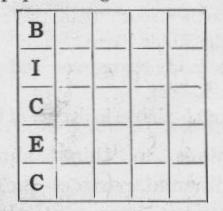
"B" is the first letter in the name of a city you have visited. Fill the other squares in the top row with the other letters in this name. "I "is the first letter in the name of a country you have visited. Fill the other squares in the second row with the other letters in this name. In a similar way, fill the remaining squares in the last three rows so that the letters in them will spell the names of a city, a country, and a river that you have read about in the preceding pages.
2. "Jumble Square":
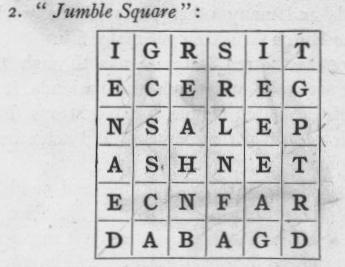
The letters in the first row of the above diagram spell, if correctly arranged, the name of a river you have seen on your journeys. Draw a framework of squares, like the one shown here, and arrange the letters of the first row so that, in your diagram, they spell the name of this river. Arrange the letters in the second row so that, in your diagram, they spell the name of a Mediterranean country. In a similar way, arrange the letters in the remaining rows so that they spell, in turn, the names of two cities on the coast of the Mediterranean Sea, a Mediterranean country, and a city visited in your earlier travels.
3. Making puzzles: It is as much fun to make a "jumble square" puzzle for others to solve as it is to solve one. To make one puzzle, select five names of five letters each. These names, of course, should be the names of places you have read about in the stories of these "journeys." In the first row, jumble the letters of one of these names; in the second row, jumble the letters of another of the names, and so on. To make a seven by seven puzzle, you must find seven names of seven letters each. To make an eight by eight puzzle, you must find eight names of eight letters each. You might try to see which of you can make, from place names you have found in this book, the "jumble square" puzzle with the largest number of squares.
You also might make puzzle books in which to copy one another’s puzzles.
4. A river puzzle:

Try to arrange the letters in these frames so that they will spell five place names used in this book.
Do not shift letters from one frame to another. Try next to arrange the names themselves in a column so that their initial letters will spell the name of a great river.
Next Chapter
Return to Table of Contents